Project model
Geometry, properties, load cases, boundaries and target quantities are derived from the engineering decision and documented.
Methods & validation
Model setup, numerical checks, reference cases and comparison with measurements are planned around the engineering task.
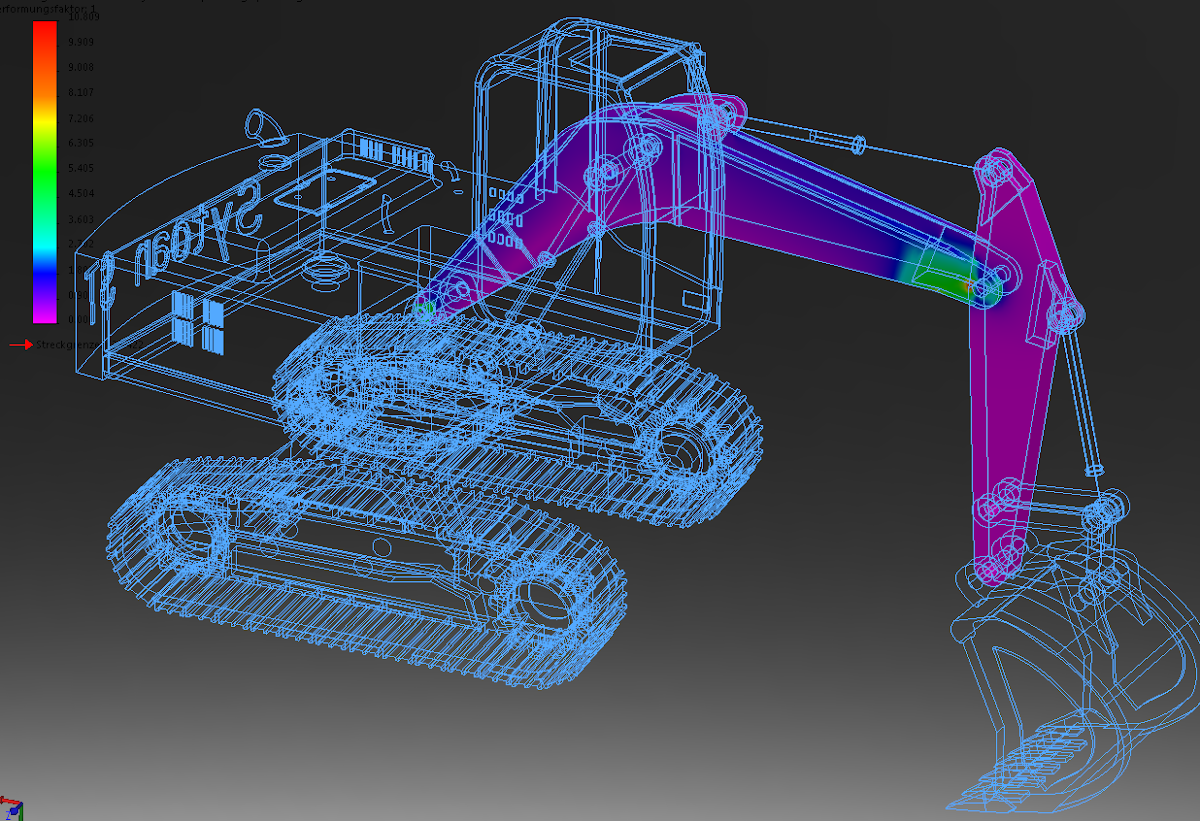
Geometry, properties, load cases, boundaries and target quantities are derived from the engineering decision and documented.
Mesh, convergence, balance quantities and sensitivities are checked in proportion to the risk and decision.
A standardized case checks a specific model and solver configuration against a published target value.
Comparison with suitable measurements evaluates predictive quality for the application studied.
FEA benchmarks
NAFEMS cases LE1 to LE4 calculated with CalculiX using model meshes from Gmsh and Netgen.
| Case | Quantity | Reference | Gmsh + CalculiX | Netgen + CalculiX |
|---|---|---|---|---|
| NAFEMS LE1 | σyy | 92.7 MPa | 91.248 MPa (−1.566%) | 92.943 MPa (+0.262%) |
| NAFEMS LE2 | two stress values | 60.0 / 60.0 MPa | 60.97 / 62.49 MPa (+1.62 / +4.15%) | 59.47 / 62.64 MPa (−0.88 / +4.40%) |
| NAFEMS LE3 | x displacement | 185 mm | 185.66 mm (+0.36%) | 184.51 mm (−0.27%) |
| NAFEMS LE4 | meridional / hoop stress | −50.0 / +50.0 MPa | −50.202 / +50.337 MPa (+0.40 / +0.67%) | −51.584 / +48.469 MPa (+3.17 / −3.06%) |
Solver, meshing path and post-processing are selected for the physics, available data and required level of detail.
CFD solver ecosystem for flow and heat-transfer models
Solver for structural and thermal finite-element models
Meshing and preprocessing for selected computational models
Quantitative post-processing and visualization of result fields
Automation, reproducibility and variant execution
Project standard
Methods proportional to risk